Read the prompt
You get a category and 30 seconds. Think of an answer that fits.
NOILLIRK / FIELD NOTES
A visual guide to the Daily Dive
One familiar answer can change the whole view. Play the Daily Dive, then follow the reveals, scores and little surprises that make each run different.
An independent fan guide. The playable game below comes from noillirk.com.
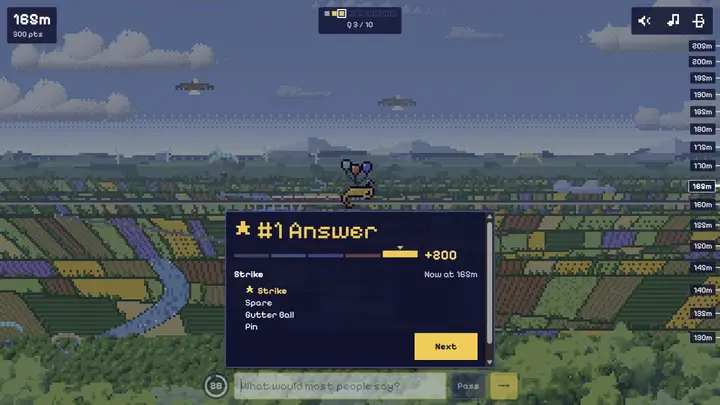
01 / PLAY
Make your pick. See where the crowd goes.
New prompts every day at midnight. Prefer the full screen? Open noillirk.com.
FROM THE GAME
These are direct screenshots from a real Noillirk Daily run, from the first prompt through the changing climb scenery.
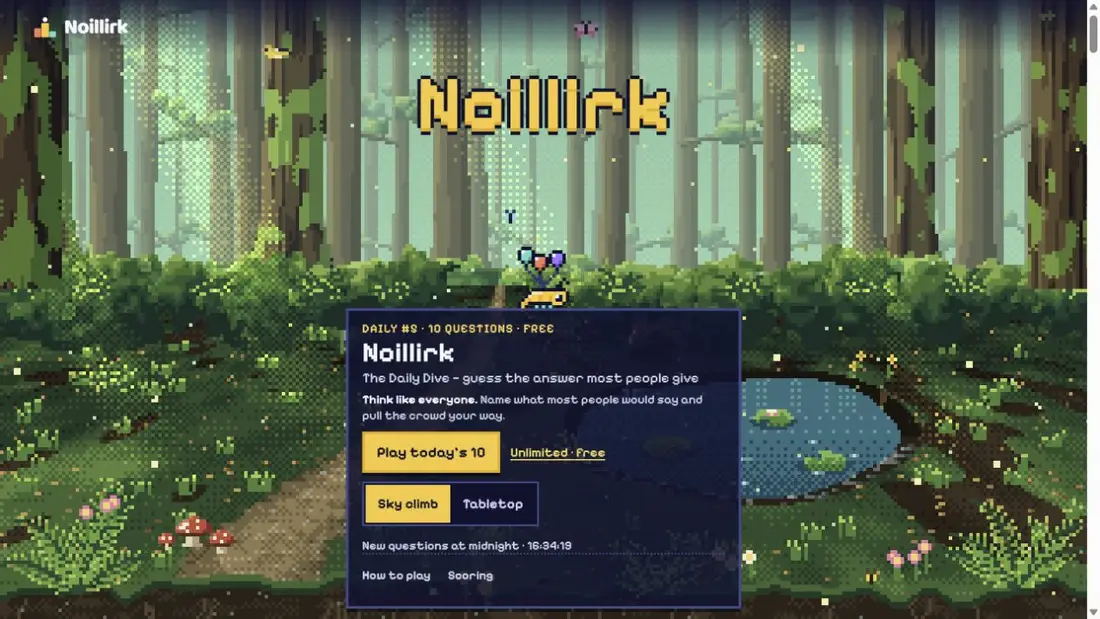
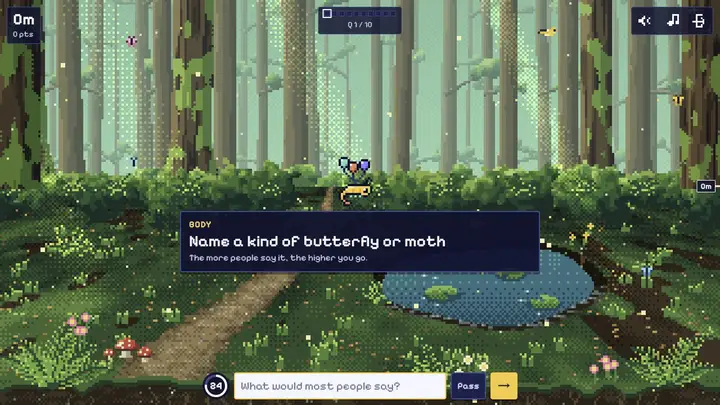
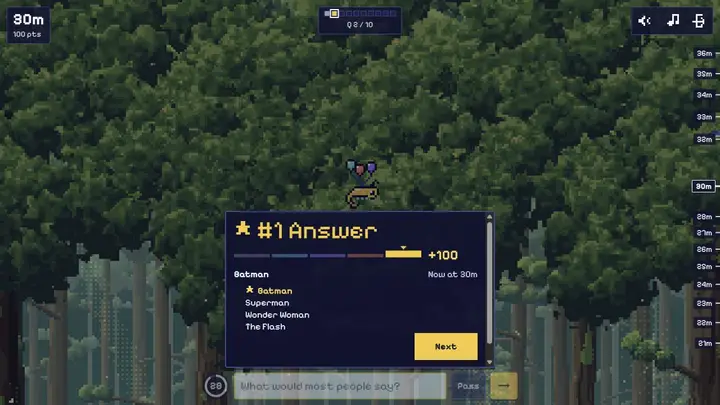
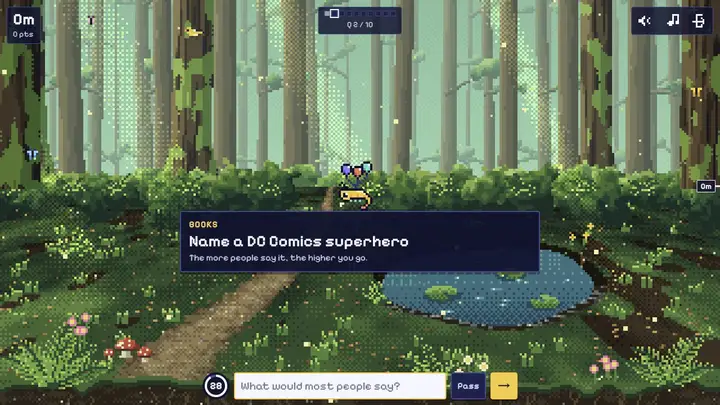
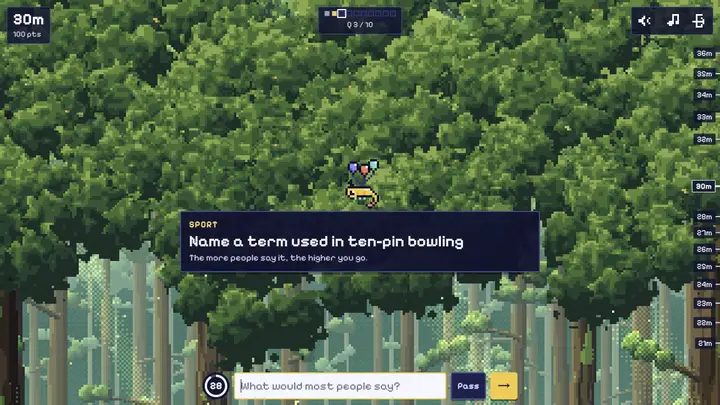
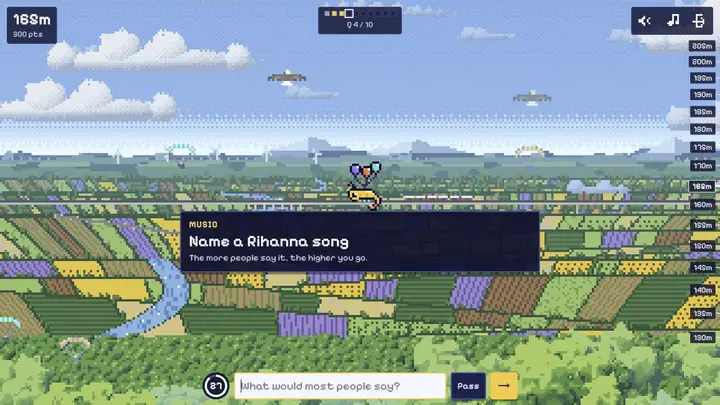
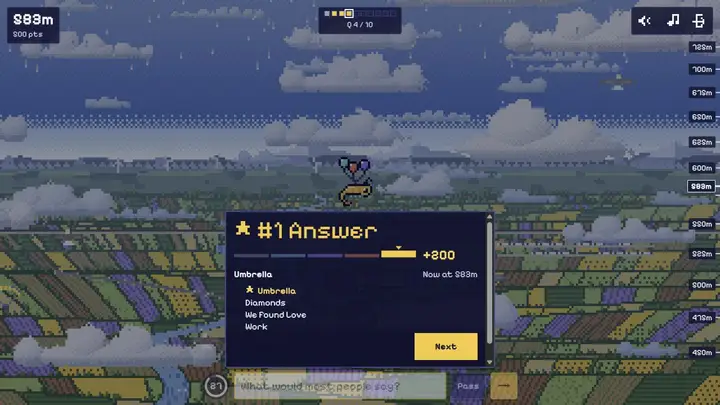
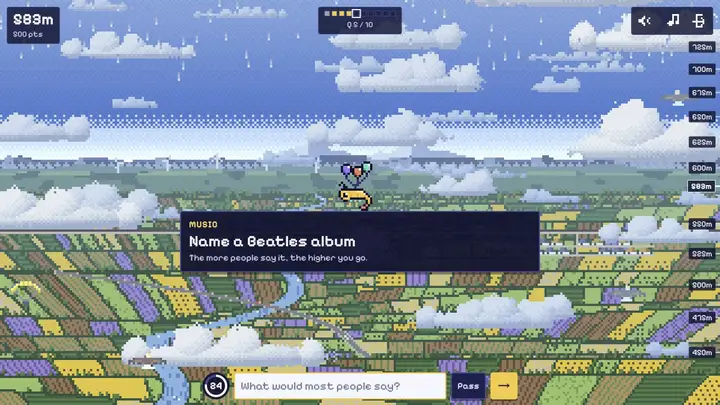

Captured from the live game on noillirk.com on October 19, 2026. Prompts and scenery may change between runs.
02 / THE IDEA
Noillirk rewards a common answer, not an obscure fact. Each prompt names a category; your job is to guess what others would say first.
You get a category and 30 seconds. Think of an answer that fits.
Type the familiar answer that would come to most people's minds.
The closer your answer is to the board's top pick, the more points and people you gain.
A QUICK EXAMPLE
Paris is a safer crowd guess than a less familiar capital. Both may be valid, but popularity sets the score.
03 / THE SCORE
A valid answer can score even if it is unusual. The game groups answers into five bands. Later Daily questions multiply the points, so a popular answer can change your run quickly.
Base points before each question's multiplier.
04 / THE FULL GUIDE
A complete, plain-English walkthrough of the rules, the scoring, the crowd, the boards, the streaks and the small habits that separate a 30-figure run from an 80-figure one.
If you have never played Noillirk and you want the short version before you read the long version, this is it. There are ten prompts. Each prompt names a category and gives you thirty seconds to type one answer that fits it. You are not trying to be right in the sense of being accurate; you are trying to be right in the sense of being what most people would say. That is the whole game, and everything below is a detail of it.
Press the yellow button, and read the first prompt carefully. The category is the important part: "Name a capital city in Europe" and "Name a European capital that starts with a vowel" are different games, and the second one has a much smaller room. Before you type anything, spend two seconds asking yourself: what is the first thing that comes to mind when I read that category? Not the best answer, not the most impressive answer — the first one.
Type it. Hit Go. Do not wait for the timer. The reveal will show you the top five of that prompt's board, and that is the single most useful piece of information you will get all day. Paris, London, Rome, Berlin, Madrid for European capitals. Read it, notice whether you were on that list, and notice where.
Keep going at pace. The pattern that works is: read, first thought, type, submit, read the board, next prompt. The most common mistake at this stage is treating a later prompt as harder than it is and slowing down. Later prompts are worth more points, but they are not harder — the board is usually the same shape, and a prompt worth 400 points is still answered in four seconds with the most obvious answer in the category.
You are halfway. This is where most first-timers make their biggest mistake: they start reaching for a cleverer answer because they want to "earn" the points. Resist it. The band you are given is decided by the board, and the board is decided by what a hundred ordinary people would type. The clever answer is almost always a band or two lower than the obvious one, and the crowd follows the obvious one.
Questions six to eight are the ×3 ones, and question nine and ten are ×4. This is where a single good answer changes the run. A #1 Answer on question nine is 400 points, which pulls sixteen figurines, which is a sixth of the entire crowd arriving at your tile in one step. If there is one prompt in the day where you should be completely certain of the most obvious answer, it is one of the last three.
The tenth prompt. Same routine. Whatever you have written down, submit it, and then read the result card properly rather than skipping to the number. The result card shows your figurine count, your title, and your three best and three worst prompts. The best and worst ones are the lesson: they tell you which categories you read well and which ones you are still guessing at.
You are done, and you are faster than you thought. Tap Share & challenge if you want to send the run to someone, and then stop. The next Daily arrives at midnight, the streak increments by one, and the whole thing takes five minutes. That is the deal: a small daily pleasure, a streak that never punishes you for missing a day, and a score that is decided by how well you read people rather than by how much you have memorised.
That is the entire game. Everything else in this guide is the reasoning underneath those ten minutes, and you can read it in whatever order suits you — the scoring in detail, the strategy, the boards, the crowd, the streaks, the prompt bank, the design, the glossary, the community, playing on a phone, and what to do when something goes wrong.
Noillirk is a daily web game you play in any modern browser on a phone, tablet, laptop or desktop computer. There's no install, no signup and no paywall. The whole thing lives in one tab, and a Daily takes at most five minutes from start to finish. The rules are short, the pacing is generous and the vibe is closer to reading a room than collecting trivia facts.
Every Noillirk Daily is ten prompts, and each prompt gives you thirty seconds. A prompt names a category — say "Name a capital city in Europe" or "Name a Pixar film" — and your job is to type a single answer that fits. The clock starts the moment the prompt appears, and a thin warm bar along the bottom of the answer card shows how much time is left. You can submit early with Enter or the on-screen Go button, you can skip with the Skip button, or you can wait the timer out. Any accepted answer scores something, so a quick guess is never wasted.
The first thing to notice is that almost every prompt has many right answers. That's the trick: Noillirk accepts most sensible responses in a category, so the question isn't "do you know the answer", it's "do you know the answer most people would give first?" Every prompt has a top-five board prepared in advance, which is the list of the five answers the Noillirk team expects most people to type, and your small raspberry figurine will land somewhere on the table based on where your guess sits on that board.
A Noillirk round is the same ten beats every time. Here they are in order, so you know what to expect on your first go.
Your answers are stored in this browser, on your own device. Noillirk does not ask you to make an account, and it does not upload your answers to a server to keep them. Your progress, your streak counter, your language choice and your Unlimited session totals live in localStorage. That means: if you switch browsers, clear this site's data, or come back from a different device, that progress belongs to the place you played and does not follow you around. If you want to play against a friend who lives across the world, the share cards and challenge links are the way to send your run there.
For the Daily, that's all you need: ten prompts, your answers, a single daily result. For Unlimited, the game keeps a longer-running session count — how many runs you've taken, how many perfect rounds you've cleared — also on your own device. The game sends a small number of anonymous page-load events to a self-hosted Plausible analytics endpoint so the team can see which prompts are working, but no answers, no nicknames and no identifiers ever leave your browser.
You can switch between two stages with a small toggle on the start screen. The default is Sky Climb, which is the easier-to-read shape on a phone: instead of dots walking across a table, you watch a tiny krill — the small mascot of the game — rise on three balloons, one for each point milestone. The mechanics are exactly the same — same prompts, same board, same points, same bands — only the presentation is different. Tabletop shows the full crowd walking across the table toward your tile, which is the prettiest view on a wider screen.
If you're playing on a desktop or a laptop, Tabletop is the prettiest. On a phone in portrait, Sky Climb keeps the answer box and the on-screen keyboard out of each other's way for the full round. Try both and stick with the one you like; you can swap any time before you press Play, and the game's challenge links remember your choice so that your friend sees the same stage you saw.
You'll see the time-out card with a small "no answer this round" message, your streak stays where it is, and the next prompt loads. Skipping a prompt (with the on-screen Skip button) does the same thing and never costs you anything beyond the lost base points. The Daily never throws a wrong answer at you — there is no such thing as a wrong answer in Noillirk — only an Off the Board answer that scores 10 points, or no answer at all, which scores zero. There's no penalty for trying, and there's no shame in missing a day.
Mobile browsers were the second platform after desktop for the team, and the answer card is positioned to stay above the on-screen keyboard while you type. You can play a Daily on the bus, on a coffee break or in the back of a long meeting, and the only thing you need is a finger and thirty seconds of free attention. If you add the page to your home screen from Safari or Chrome, it acts like a small app — the Noillirk logo, no address bar, full screen — and it will load right into today's prompts the next time you tap it.
That's the whole tour. Read the next section to learn what those 10, 25, 50, 75 and 100-point numbers mean, how the multiplier on questions three through ten works, and how a Daily can climb from a few hundred points to a perfect 2,500. The rules are short, the crowd is friendly, and the rest is just typing what comes to mind.
Most trivia games have one right answer and reward whoever finds it first. Noillirk is the opposite: most prompts accept many right answers, and the reward depends on where your answer sits on the prepared board for that prompt. The board is the team's best estimate, made in advance, of how 100 people would respond, ordered from most popular to tenth, and your place on it sets your band for that prompt. There are five bands, and each band has a base point value that combines with a question multiplier for the final score of that prompt.
Every accepted answer lands on one of five bands. From top to bottom of the board, they are #1 Answer, Runner-up, Top 5, Top 10, and Off the Board. The point values are tuned so that the most common answer is worth ten times an Off the Board answer, and the in-between bands sit on a roughly geometric ladder.
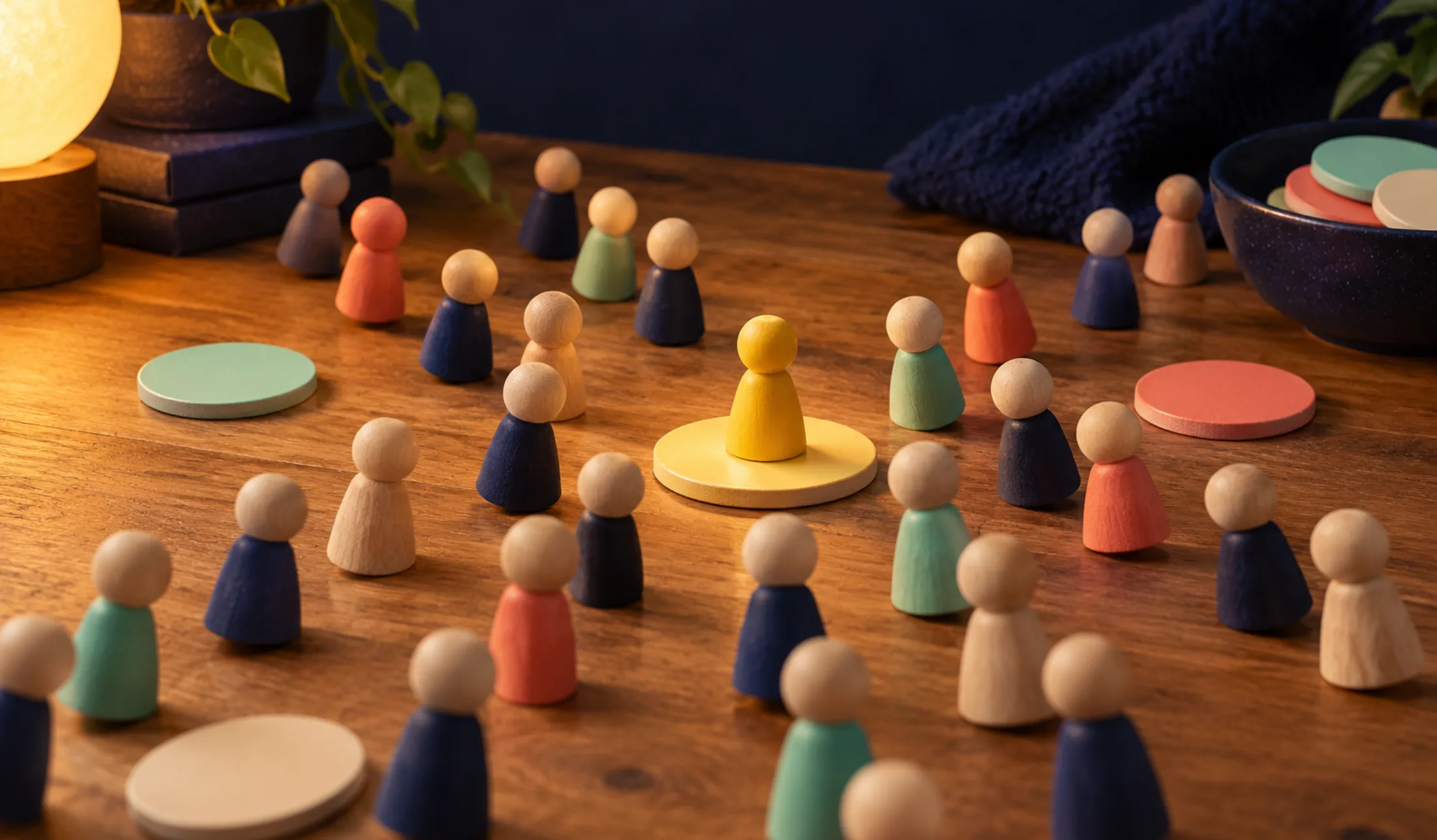
The base point is multiplied by the question's position in the Daily. The first two questions of the day are x1: their base points are exactly what they are. Questions three, four and five are x2. Questions six, seven and eight are x3. Questions nine and ten are x4. This means the late-game questions are where the day's score really climbs, and a single #1 Answer on question ten can be worth 400 points on its own.
The multiplier isn't a surprise: it's printed on the prompt card just above the question text, so you always know whether you're answering for the base or for a multiple. Multipliers exist so the late-game questions carry more weight without the bands needing to look imbalanced — the same #1 Answer is 100 points on question one and 400 points on question ten, but the visual ladder on the board is identical across all ten questions.
Beyond the points, the reward you can see in Noillirk is the figurines themselves. There are 100 little wooden figurines on the table at the start of every run, and after each prompt a slice of them walks over to your home tile. The rule is simple: every 25 points in the round pulls one figurine to your tile, regardless of band. A prompt that scores 25 base points pulls one figurine; a prompt that scores 200 (a #1 Answer on x2) pulls eight; a prompt that scores 400 pulls sixteen. The figurine count on the tile tallies up like a ring counter.
At the end of a run the result card summarises: You pulled X of 100. A perfect Daily — ten #1 Answers — pulls all 100. A round with mostly Top 5 answers might pull 60. An Off the Board day might pull 20. The figures are how Noillirk knows who really read the room, and they're what the challenge board compares.
Let's walk through a real example, since the numbers matter to the feel of the game. The prompt is "Name a capital city in Europe", and the team's pre-built board ranks the answers like this:
Now suppose this prompt is question four of the day, which carries a x2 multiplier. The score card on the reveal would show:
Two things stand out: the #1 Answer is worth ten times the Off the Board answer, and the figurine count moves in increments of one (rounded down) because 25 points is the threshold. Length, spelling, capitalisation and cleverness don't matter — only how many people would say the same answer.
Each prompt has a prepared list of accepted answers, with a small allowance for common variants, plurals, capitalisation and minor typos. "The Moon", "the moon", "Moon" and "Earth's moon" will all count as the same answer for most moon prompts. "Sushi" and "sushis" both count for a food-sushi prompt. "Toy Story" and "Toy Story (1995)" both count for a Pixar prompt. The game tries to lean toward accepting what you meant, because the lesson of a missed prompt is more interesting than the score on the missed prompt.
If you pass or run out of time, the result card has a small "Should this count? Tell us" button for answers you think we missed, and every guess the game turns down is logged anonymously so the team can add the ones that should count.
A title summarises how the round went. From closer to #1 to further from the top, the six titles are:
The titles are more flavour than scoring; they appear on your share card and let your friend see how the round read at a glance. Two players who both pull 70 of 100 can end up with different titles, because a balanced day of Top 5 answers and a wild day of mostly Off the Board answers tell different stories.
The whole scoring system is a deliberate inversion of the trivia genre. Knowing a lot helps a lot, but thinking like everyone else wins. A player with a small but very mainstream vocabulary of facts can pull a full crowd just by saying the most obvious answer first. A player with deep trivia knowledge can pull a small crowd on a tougher prompt because they went for the precise answer instead of the common one. Either can be the right strategy on the day — it depends on the prompts and the company you're keeping.
Noillirk rewards the answer that the most other people would give. That's not the same as the correct, the obscure or the clever answer — it's the one that comes to mind first when a hundred players see the same prompt. Reading that mind-set is the whole game, and it's a learnable skill, but the trick is that it isn't a single skill: it's three habits running together.
The first habit is to say your first thought. In most trivia games, thinking longer improves your answer. In Noillirk, thinking longer usually moves you down the board, because the first answer that comes to mind is also the first answer that comes to most other people's minds. The board ranks by what 100 people would type first, and your instinct is one of those hundred. If the prompt is "Name a Pixar film" and your first thought is Toy Story, that's probably the #1 Answer — type it. The extra second of pondering will only push you toward something more sophisticated.
The second habit is to reach for the most famous member of a category. The best-known member of a category is usually the #1 Answer, because fame is mostly correlated with frequency-of-thought. The Moon is the #1 Answer for a "moon in our solar system" prompt, even though dozens of moons are technically correct. Paris is the #1 Answer for a European capital prompt. Pizza is the #1 Answer for many Italian-food prompts. The famous one wins.
The third habit is to beat the clock. Thirty seconds go fast. Any accepted answer scores, so a quick guess is never wasted, while a perfect one still in your head when time runs out scores nothing. That's the most counter-intuitive part of Noillirk: the 25-point Top 10 answer you type in three seconds is worth more than the 100-point #1 Answer you hesitate on. After every guess the result card shows "Our board Paris, London, Rome, Berlin, Madrid (est.)", the board's top five, so each prompt teaches you where the room's mind went.

A useful mental model is to think of each prompt as a ladder with four stops, going from least-crowded to most-crowded. The stops are too clever, holiday favourites, big and famous and what everyone says. The #1 Answer almost always lives at stop four, the very bottom of the ladder where the obvious answer sits.
Take the prompt "Name a capital city in Europe" again. Here is the same example as a ladder:
Most prompts have a similar shape. For a "name a breed of dog" prompt, the ladder is something like Saluki (stop one, Off the Board), Corgi (stop two, Top 10), Golden Retriever (stop three, Top 5), Labrador (stop four, #1 Answer). For "name a Beatles song" the ladder is "I Am the Walrus" (stop one), "Let It Be" (stop two), "Hey Jude" (stop three), "Yesterday" or "Hey Jude" close together (stop four). Your job is to climb as far down the ladder as you can in the time you have.
There's a single trap that catches every Noillirk newcomer, and it's worth naming plainly: the trap of correct-but-obscure. It happens because trivia training tells you that the more specific, more accurate, more clever your answer is, the better. In Noillirk, that's inverted. "The Moon" scores more than "Io" for a moon prompt. "Toy Story" scores more than "Ratatouille" for an early Pixar prompt. "Pizza" scores more than "Risotto alla Milanese" for an Italian-food prompt.
When you catch yourself starting to type a more elaborate answer, swap it back to the most obvious one. Don't be the player who ended the round with seven Off the Board answers because they kept reaching for the deepest trivia answer instead of the most popular. The two habits — say your first thought and reach for the famous one — push back against the same trap from different angles.
The first hint of a prompt is the category wording itself. "Name a capital city in Europe" is an open prompt that accepts many right answers. "Name a capital city of an EU member state" is narrower and biases the board toward Brussels, Berlin, Paris, Rome and Madrid. "Name a capital city whose name begins with a vowel" is even narrower, and most players will land on a small, predictable list. When the prompt is narrow, the board compresses; when the prompt is broad, the board spreads.
This matters because narrow prompts make the #1 Answer very predictable: there's usually one well-known member that fits the constraint, and a #1 Answer scores more in a narrow prompt than a broad one simply because the room has fewer options to choose between. Conversely, broad prompts spread the board across many plausible answers, which means even the Top 5 is contested — and a clever Top 10 answer is worth the same 25 points.
Sometimes the clock ticks and you can't find a sensible answer. Noillirk accepts many answers, but if a prompt is too narrow, too local or too domain-specific for your taste, you can skip. A skipped prompt scores zero, but a generous skip at the start of a question saves your streak in the long run, because the prompts you're strong on are still ahead. (Note: skipping does not break a streak. Only missing the day's first prompt resets the streak, and only if it's already at zero by midnight.)
Noillirk Unlimited is the place to practise the strategy, because there's no daily cap and no morning deadline. Take a 10-prompt Unlimited run after a Daily to feel out prompts you missed. Take a 20-prompt run on a slow afternoon to bank three or four rounds in a row, and you'll see your title mix shift toward Mind Reader and Crowd Whisperer.
The strategy is small, simple, and it pays back fast: say the first answer that comes to mind, reach for the famous one, and submit before the 30 seconds are up. Three habits. That is most of the game.
Noillirk Unlimited is the same game as the Daily, with one big difference: there is no daily cap, no calendar, no streak to maintain, and no schedule. Press Play, take 10, 20 or endless prompts from the whole prompt bank, and stop whenever you like. Every Unlimited run counts toward its own session total in this browser, and you can also challenge a friend to play the same prompts so the two of you land on the same board.
If the Daily is your morning routine, Unlimited is your warm-up, your evening wind-down and the place to learn what each prompt's board feels like. The mechanics are identical to the Daily, with the same bands, the same multipliers and the same figurines walking to your tile — but without the midnight rollover and without the streak pressure, so the prompts become a workspace, not an event.
When you enter Unlimited, you pick a session size: 10, 20 or endless. Ten is the closest to a Daily, and it's a great warm-up for the day or a quick blast when you only have a couple of minutes. Twenty is the sweet spot for a focused session: long enough to feel out the prompt variety, short enough to keep your mind fresh to the end. Endless is for the day you're feeling it — pick up where a previous endless run ended, stop any time, and your progress and figurines persist across the runs.
There's no scoring penalty for ending an endless run early, and your figurines don't reset between sessions. If you pulled 14 last time and you pull 22 this time, your home tile carries 36 figurines across the two runs. (Note: the figurines in Unlimited are separate from the figurines you pull in a Daily, by design: the Daily has its own board to compare with friends, and Unlimited has its own pace.)
Guessing what most people say is more fun against someone you know. Every Daily share, and every share of a 10- or 20-prompt Unlimited run, carries a challenge link that opens at https://noillirk.com/c/<random-id>. When your friend opens the link, they play the exact same prompts in the exact same order. After they type each answer, your figurine shows up on your tile — the one you chose — so they can see where you landed before they decide their own answer.
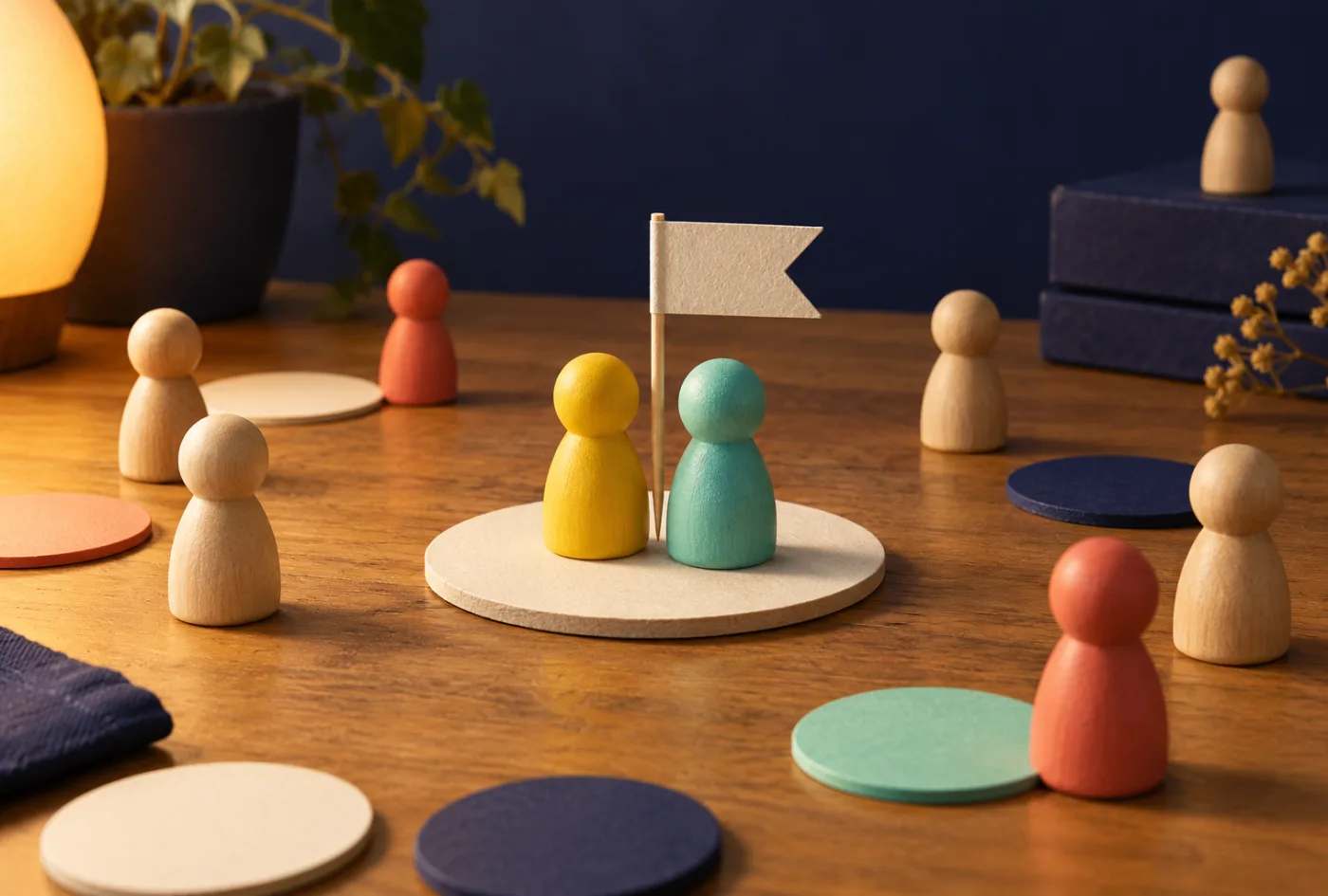
The challenge link does not reveal the answer you'd already typed — that would be cheating — but it does reveal the band you landed in. So if your friend saw you pulled 8 figurines on question four because you typed Paris, they'll know you landed on the busy tile, and they can decide whether to chase Paris, too, or branch out and try for something different.
Everyone who plays a single challenge link lands on one shared board for that link. The board ranks players by how many figurines they pulled and then by points, and a percentile — for example, "Top 12% of all challenge-link players today" — sits next to your name. The board is small and friendly: most challenge links have somewhere between two and twenty players, depending on how much you share them.
When your friend then shares their result with their own link, their challenge brings new players to the same board, so a whole group can end up playing one challenge. It's an easy way to play with friends online: no account, just a random nickname like "Swift Otter" that you can change before you send. Noillirk generates nicknames automatically so you never have to choose one in a hurry, and the share sheet offers a quick customisation.
To make the board and today's percentile work, Noillirk keeps each finished run for the lifetime of a challenge: your nickname, your answers, your score and a random id created in your browser. There is no account, no email, and no third-party tracker. The data is stored against the random id, and a random id is never linked back to a browser, a device or a person. When the challenge expires — usually a few weeks after the last prompt — the data is deleted from the server. Nothing is kept forever.
Plausible analytics (a small, self-hosted Plausible instance) sees anonymous page-load events: someone opened this page, someone clicked play, someone finished a run. Plausible doesn't see answers, nicknames, scores or challenge ids. The team uses that data only to know which prompts are working for players and which aren't.
The best challenges are short, focused, and easy to share. A 10-prompt Daily share is a great default — it's a complete round, it has a single board, and the share text is one line. A 20-prompt Unlimited run is for when you and your friend have a longer window. Endless runs work, but the share text gets long.
If you want your friend to play without revealing how you did, share the link first and ask them to play it before you share your result. The link is the same in both directions; only the result is asymmetric. That's the cleanest way to keep the game honest and the scores comparable.
Unlimited and challenge links together turn Noillirk from a solo puzzle into a small social game, with a single random link standing in for a multiplayer lobby. If you have a busy friend, send them a Daily challenge at the start of their day; if you have a friend online at the same time as you, race through 10 prompts and see whose figurine ends up with the larger crowd. The mechanics are the same; the company is what changes.
At the end of every Noillirk run, the result card offers a Share & challenge button. Press it and the game prepares a short text summary, three ready-made share cards, and a challenge link you can send to a friend. The text doesn't reveal your answers, only the figurine count and the bands you landed in, so the Daily stays fair for anyone else who plays the same day.
The three default share cards cover the most common ways people want to share a run. Each is a square image, designed to look right whether you're posting it on a chat app, a social feed or a Discord channel.
The share text is a small block designed to fit cleanly inside a single chat bubble. It looks something like this:
Noillirk Daily · 🧍38/100
⚪🔵🟣🔵🟠⚪🟣⚪⚪🟡
Close Call · day 12
noillirk.com/c/…
Each coloured circle in the second line is one prompt, with the band's colour filling the circle: tomato for #1 Answer, marigold for Runner-up, cobalt for Top 5, lavender for Top 10, and pale grey for Off the Board. The texts read the run at a glance, and they don't reveal your answers, only your bands. The third line carries your title and streak, and the last line is the challenge link.
The colours are deliberately accessible: even a colourblind reader can distinguish tomato from lavender by the lightness and the position in the row, and the layout works in greyscale if the colours fail. The team tested the cards in dark mode and light mode chat apps, and the design passes both without a separate variant.
The team's biggest design choice on sharing is that the cards and the share text don't reveal your answers. They reveal your figurine count, your bands, your title and your streak, but not the actual words you typed. The reason is that the prompts of a Noillirk Daily are reused across many Dailies, and giving your friend a free answer would let them skip the prompt when it comes round again.
When you want to give someone a fully transparent share, the answer review link in the result card does reveal your answers — but only to people who already played the same challenge. The link includes a flag that says "answers visible", so the recipient knows in advance. Outside of that, the public text never spoils the prompt.
Sharing an Unlimited run works the same way as sharing a Daily, except the share text reads "Unlimited · 🧍X/100" instead of "Daily · 🧍X/100", and there is no streak. You can share a 10-prompt Unlimited, a 20-prompt Unlimited or a 100-prompt Unlimited — the share cards and the share text are the same shape, regardless of length.
If you want to share a run with a friend's specific challenge link, share the link, not the cards. The cards can be sent anywhere, but the challenge link only works for the friend you've challenged. The cards are general; the link is private.
Noillirk's share cards are squares because the chat apps and social feeds people share them on all support squares equally well. A square card renders fine on Instagram, X, Reddit, Discord, iMessage, WhatsApp, Telegram and Signal without any cropping. The team tested other aspect ratios (16:9 horizontal, 9:16 vertical) and the square was the only one that survived all of them at full size.
If you want to share a card in a context that prefers another aspect ratio, the team has a small built-in cropper that lets you choose between square, 16:9 and the original card shape. The 16:9 version is a landscape crop that loses some of the tile detail, but it can be useful for YouTube thumbnails and Twitter cards. The 9:16 version is a vertical crop that loses the right-hand side of the board, but it works on Instagram Stories and TikTok.
When you share a Noillirk run, no signals are sent to the team. Sharing is a purely client-side operation: the cards are generated on your device, the link is generated on your device, and the link is sent to your friend over whatever app you used. The team never sees the cards or the link unless your friend plays the challenge and the challenge registers as a finished run.
This is a small but deliberate choice: the team wanted sharing to feel private and inclusive, not tracked. The only thing that crosses to the team's servers is the finished-run data on the challenge board — your nickname, your answers, your score — and that data lives behind the challenge id, which is a random string of letters and numbers.
Noillirk prompts come from everyday categories: places, food, music, books, sport, the human body, things you'd find in a house. Each one names a category in plain words and accepts a wide range of answers in that category. The trick of Noillirk is that the better-known members of any category are almost always the #1 Answer, so a player with general knowledge — but no trivia flexes — can pull a large crowd simply by reaching for the obvious member.
Below is a tour through the categories the team draws from most often, with examples of the kind of prompt you'd see and the kind of band the obvious answer would land in. The exact boards rotate weekly, but the shape of each category stays roughly the same, so this section doubles as a primer on what to expect when you open the morning's Daily.
Place prompts are the bread and butter of Noillirk. They include everything from "Name a capital city in Europe" to "Name a country in Africa" to "Name a famous landmark in Asia." The board for a place prompt is shaped by how broad the prompt is: a continent-level prompt spreads the board across many options, while a constraint like "begins with a vowel" or "island nation" narrows it to a small list.
The boards for capital-city prompts are usually won by the cities most people visited as children or saw in films. Paris, London, Rome, Tokyo, New York and Beijing are recurring #1s. Boards for country prompts usually have one or two uncontested leaders and a long tail: "Name a country in Africa" gives you Egypt and South Africa at the top, with dozens of plausible countries behind. The advice for a place prompt is to reach for the most famous member and let the board surprise you if it lands somewhere else.
Food prompts include cuisines ("Name a Japanese dish"), specific dishes ("Name a pasta"), drinks ("Name a type of tea"), and even flavours ("Name a sweet smell"). The boards here are unusually predictable, because food is a category everyone has strong first-instincts about. Sushi, Pizza, Tacos and Burger are nearly always #1 in their respective prompts. The Top 5 expands with regional variants and popular second choices, and the Off the Board answers are the ones you only think of when you're really hungry.
One tip: when a food prompt involves a less obvious category — say, "Name a type of mushroom" or "Name a Scandinavian spirit" — the board compresses toward fewer plausible answers. In those cases, the most famous member is even more dominant, and the figurine count is correspondingly dense on the #1 tile.
Music prompts include songs ("Name a Beatles song"), artists ("Name a 90s rock band"), genres ("Name a type of electronic music") and instruments ("Name a woodwind instrument"). The shape of the board depends on the prompt's specificity: a genre-level prompt has a clear leader with a long tail, while a song-level prompt is contested by songs with very high fame.
The boards for "famous song" prompts are interesting because the very top answers are usually songs from a different era than you'd expect. The #1 Answer for "Name a Beatles song" is often Hey Jude or Let It Be, not the band's deeper cuts. The #1 Answer for "Name a Queen song" is Bohemian Rhapsody. The team's editorial choice is to keep the boards trending toward the songs a casual listener would name first, which is what 100 people in a room would actually say.
Pop-culture prompts cover the rest of the cultural space. Books ("Name a classic novel"), films ("Name a Studio Ghibli film"), TV shows ("Name a sitcom that ran for ten seasons") and games ("Name a Nintendo franchise") all behave similarly to music prompts: the #1 Answer is a famous thing everyone has heard of, and the Off the Board answers are things you only know if you collect that category.
Animation prompts are particularly clean: Pixar films trend toward Toy Story as #1, Studio Ghibli films trend toward Spirited Away, and Disney films trend toward The Lion King. The boards are predictable, and the figurine count on the top answers is high. Bonus trivia: a handful of "Name a Pixar film" prompts appeared in earlier Dailies, and the team's prepared list covers most of the catalog.
Sport prompts include individual athletes ("Name a famous tennis player"), teams ("Name an NBA team"), sports themselves ("Name an Olympic sport") and championships ("Name a Grand Slam tournament"). The boards for athlete prompts are dominated by global names — Federer, Messi, LeBron — while team prompts are dominated by teams with international followings, regardless of where you live.
Note that some sport prompts are deliberately narrow: "Name a Tour de France winner" or "Name a tennis player with more than 20 Grand Slam titles" produce boards where the room mostly agrees, and a #1 Answer is worth a very large crowd. Other sport prompts are broader, and the boards spread out accordingly.
A long tail of prompts covers people, body parts, daily life and so on: "Name a bone in the human body", "Name a profession that requires a uniform", "Name a thing you'd find in a kitchen drawer", "Name a direction on a compass", "Name a colour that goes well with red". These prompts are often the easiest of the day because the boards have a small number of obvious leaders.
The "Name a thing you'd find in a kitchen drawer" prompt, for example, has Fork, Spoon and Knife at the top of the board, with kitchen scissors and a bottle opener rounding out the Top 5. The Off the Board answers are the more specific tools — garlic press, lemon zester, strawberry huller — that fewer people think of first. The same pattern recurs across the daily-life prompts.
The team rotates prompts across the categories roughly evenly, with a few clusters on culture-heavy days (a music + film + book combo, for instance) and a few lighter days with more body and daily-life prompts. Every prompt is on a board with a relatively long shelf life — a prompt with a strong board can appear in three or four Daily slots across a month, while a prompt with a weak board gets bumped down the queue.
What this means for a player: if you play the Daily every day, you'll start to notice the categories the team leans on, the shapes of their boards, and the kind of answer that always wins. Over time, your mental library of #1 Answers grows, and your title mix shifts toward Mind Reader and Crowd Whisperer. The practice isn't memorising answers — it's memorising the shape of how a hundred people talk.
Every Noillirk prompt has a board attached to it, and that board is the single most important detail of the whole game. The board is the team's best estimate, prepared before the prompt goes live, of how a hundred people would respond if asked. The top of the board is the answer most people would give, then the runner-up, then down to the tenth. Your place on the board for your prompt sets your band for that prompt, and the band sets your points and your figurines.
Because the board is a forecast rather than a live count, the team's FAQ includes the qualifier "(est.)" beside it. The estimate is built from a mix of large-scale surveys, observed play patterns from previous Noillirk Dailies, and editorial sense. The numbers are good but they're not infallible; if a board undersells an answer, the team watches how often that answer actually appears and updates the board for the next time the prompt appears in the rotation.
A "live" board — counting how other players answered today — would be more accurate than an estimate, but it would also ruin the game. Once a prompt is live, the count of every other player's answer is information that no real-world game of "guess what people say" would have. The prompt would be solved in real time, and the value of reading the room would disappear. By preparing the board in advance and freezing it at the moment the prompt goes live, Noillirk gives every player the same information, and the room stays imaginary in the right way.
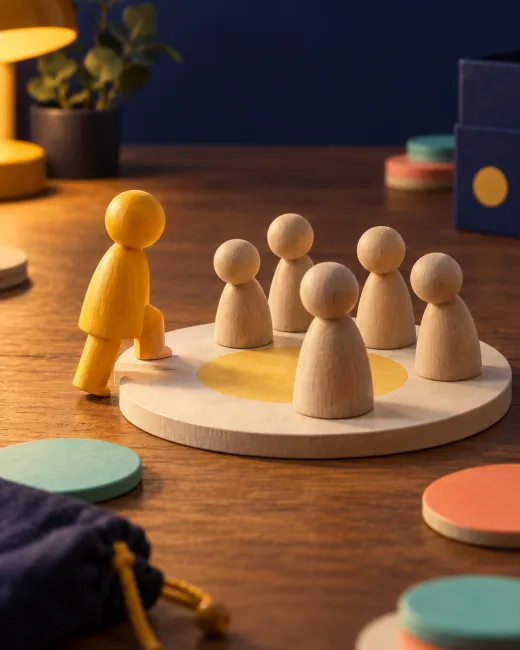
After every answer you type, Noillirk shows you the top five of the prompt's board — the answers the team expects to be the most popular — so you can learn which way the room went. But the rest of the board, from sixth down to tenth, stays hidden. The reason is pacing: if you saw the full board every time, prompts you missed would feel like spoiled rehearsals when they came around again, and the Daily would lose its freshness.
The hidden six-to-ten also keeps the band thresholds stable. Off the Board is Off the Board regardless of whether the eleventh answer is one slot below the Top 10 or way below it: the answer wasn't in the team's predicted top ten, so it sits in the lowest band. This means a player who keeps typing unusual answers can still pull a 10-point base every prompt, and the bands remain cleanly comparable across prompts.
Each prompt carries a prepared list of accepted answers in addition to the board. The board is the ranking of those accepted answers from most to least popular. The list is usually longer than the visible top five — it has to cover all the common variants, plurals, capitalisations, languages and even some near-misses. The list is what the answer checker compares your input against, with the small tolerance for typos and variations that we mentioned earlier.
The list isn't complete, and that's deliberate. A complete list would either be impossibly long or impossibly short, and either way would create edge cases. Instead the team keeps the list as long as it needs to be for each prompt and lets the "Tell us" button feed in. If your answer was reasonable and it didn't go through, you'll see a link in the result card; pressing it sends the team a non-identifying signal that the list needs to grow. The team watches the rate of these signals to decide which prompts need a refresh.
When a new prompt enters the rotation, the board is built by hand. The team starts from a list of candidate answers — things the team expects a hundred people to type — and runs them through a small internal survey of testers, who answer without knowing the board. Each tester's answer is added to the list if it isn't already there, and the most common answers bubble to the top. The team trims the list down to the strongest ten and orders them. The list is then locked and shipped with the prompt.
The board is then frozen in place when the prompt goes live, and the team watches how it actually performs over the next few weeks. If an answer that wasn't on the board turns out to be more common than expected, the team adds it. If a board answer is consistently less popular than expected, it gets bumped down on the next rotation. This feedback loop means each prompt's board gets sharper over time, and the more the team hears from players via the "Tell us" button, the more accurate the boards become.
That's the whole story: boards are estimates, the estimates are built and refined by hand, and the team is open to signals from players. If you ever feel a board missed something obvious, the "Tell us" button is the route to making it better the next time around.
The crowd is the most physical part of Noillirk. A run starts with a hundred little wooden figurines scattered around the table; after every prompt, a slice of them walks over to your tile and stays there with a coloured ring matching the band you landed in. By the end of the round your tile is the centre of a small crowd, and the figurine count on it is the number that defines the round.
The figurines are what the eye sees, and they're what the challenge board compares. But the points and the figurines are tightly linked: every 25 points in the round pulls one figurine to your tile, regardless of band. A prompt that scores 25 base points pulls one figurine. A prompt that scores 200 (a #1 Answer on x2) pulls eight. A prompt that scores 400 pulls sixteen. The figurine count on a single tile tallies up like a ring counter, and across the whole round the tile's count is your crowd.

A perfect Daily — ten #1 Answers — pulls all 100 figurines to your tile, and a perfect round is identified by that figurine count rather than the points score. The reason is that points are tied to the question's multiplier, but figurines are tied to the total run. A perfect Unlimited run pulls all 100 figurines per round, and the round ends with a small medal next to your figurine count.
The figurine count also drives the share cards. After your run, the share text reads "You pulled 38 of 100" with a row of ten coloured circles (one per prompt) showing the band you landed in. Your friend sees the figurine count before they see the run, and that's the number they remember. The number is the headline of the round.
Every figurine that walks to your tile carries a coloured ring matching the band of the prompt that earned them. A figurine earned on a #1 Answer prompt carries a tomato ring (the band's colour), one earned on a Runner-up prompt carries a marigold ring, and so on down to the Off the Board's muted blue. The rings stay visible after the figurine joins the crowd, so at the end of a long round you can see how the crowd was assembled.
The rings are cosmetic — they don't affect the points — but they're a fun way to glance at the story of a round. A tile stacked with all-tomato rings is a clear "you read the room today" story; a tile peppered with blue rings shows the run had a lot of Off the Board answers; a tile with a mix of rings tells the more interesting middle-of-the-pack story.
The figurines walk one prompt at a time, in a small group, with a short delay before each batch moves. The visual cue is intentional: the prompt reveal lasts a few seconds and the figurines walking are a key part of that reveal. You can tap the table to fast-forward the animation, but the slower default speed is friendlier to slower devices and gives your eye a moment to register how the board is shifting.
In Tabletop mode the figurines walk across the wooden table from all sides toward your tile. In Sky Climb mode the figurines are replaced by a single krill (the small mascot) rising on three balloons, where each balloon represents one of the figurine count thresholds (25, 50, 75 figurines). The krill starts at 30 metres and rises as you earn figurines, eventually reaching 14.0 km at the perfect Daily mark.
A perfect run — ten #1 Answers across a Daily, or every prompt in an Unlimited session — pulls 100 figurines to your tile. Visually, the tile becomes a small crowd: a circle of figurines all standing around your raspberry figurine, with a thick ring of tomato colour from the #1 prompts. The pose is small and friendly, and it's the reward the team wanted the game to offer — a moment where the room has read you just as well as you've read it.
On the challenge board, your figurine count decides your place. Most rounds settle somewhere between 30 and 80 figurines, with the high scores pulling the largest share of the table. A player who consistently pulls 80+ is a Mind Reader; a player who bounces between 40 and 60 is a Crowd Whisperer; a player who lands around the 30 mark might be a Close Call or Own Lane.
The figurines are also the only thing the team remembers when looking at player data: an aggregate of figure counts across rounds gives a clearer read of how a player is doing than a raw points total, because the points depend on the day's multiplier mix. The figurine count isolates the skill of reading the room, which is the one thing Noillirk is built around.
When the last prompt's reveal finishes, the round ends with the result card. The card shows your figurine count, your title, your average band, your top three prompts (by figurine count) and your three weakest prompts. Sharing the card is straightforward — it has the share text and the share image ready to copy.
If you'd like to replay the round, you can scroll through the prompt-by-prompt recap, where each prompt's reveal animates again, the figurine count tallies, and your answer is shown next to the board's top five. The recap is the same view you saw during the round, slower and out of order, so it's a great way to learn which prompts cost you figurines.
That's the whole story of the crowd. A hundred figurines start on the table. Each prompt earns you a slice. The figurine count is the headline of the round. And the rings they wear tell the story of how the round went, one prompt at a time.
The result card at the end of a Noillirk run shows two summary numbers: how many of the hundred figurines you pulled, and the title you earned for the round. The figurine count is straightforward — bigger is better, and the perfect round is 100. The title is a flavour number that summarises how you read the room, and the streaks layer on top of both.
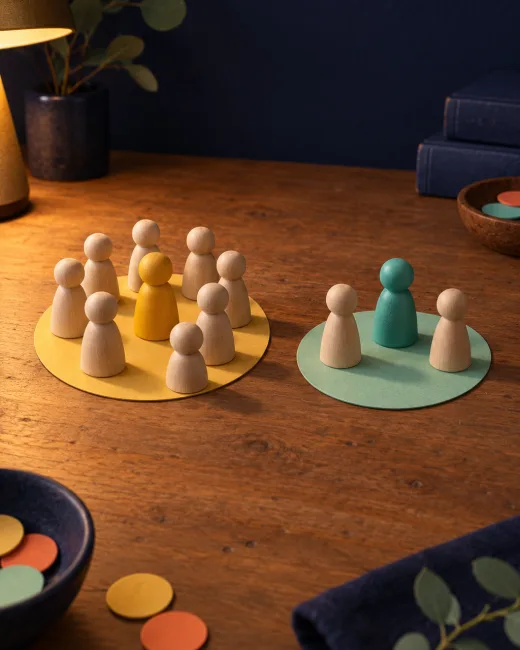
A perfect Noillirk Daily is ten #1 Answers, one per prompt, with no skips and no time-outs. The figurine count is exactly 100, the title is Mind Reader (with a perfect-day flair on the result card), and the points total is 2,500 — the formula is 100 (x1) + 100 (x1) + 200 (x2) + 200 (x2) + 200 (x2) + 300 (x3) + 300 (x3) + 300 (x3) + 400 (x4) + 400 (x4) = 2,500. The Multiplier column matters: a clean run with all x4 questions answered correctly gives you 2,500 points; a cleaner-feeling run with fewer high-multiplier answers gives a lower total without changing the title.
The team doesn't expect most players to hit a perfect Daily. The figure count for a typical round is somewhere between 30 and 80, and a typical title is Crowd Whisperer or Close Call. A perfect round is the upper edge of the game's scoring, not its centre.
Noillirk saves the date you last completed a Daily in this browser's localStorage. Each morning you finish a Daily, the streak counter increments by one. If the date in localStorage is yesterday's, the streak continues; if it's more than a day ago, the streak resets to one. The streak is per-browser, per-device: switching browsers, clearing this site's data, or using a private window doesn't carry the streak across.
The streak counter is shown on the start screen and inside the result card after a Daily, and it persists across the calendar day. If you start a Daily at 11pm and finish at 12:30am, you'll see the streak increment for the new day (since the localStorage date updates as soon as the round completes), but the prompts were the previous day's. If you don't want to play across midnight, the team recommends starting your Daily before 11:30pm, or accepting that finishing past midnight counts as the new day.
The streak counter is a motivation, not a score multiplier. There are no streak bonuses for the seventh day, no extra figurines for the thirtieth, and no reward for a year-long unbroken streak. The streak is a small badge that says you've played the Daily for that many days in a row, and that's all it is. The figurine count from a single round stays the same whether your streak is 0 or 365.
The team's rationale is that Noillirk is a small daily pleasure, not a grinding reward loop. A streak should feel like an accomplishment in itself, and combining it with a scoring bonus would tilt the game from a 5-minute coffee-break activity into something that feels more like a workout. The shorter the streak churn, the friendlier the game feels.
Every Daily share card carries the title and the figurine count; the share text reads "Noillirk Daily · 🧍38/100 · Close Call · day 12" or similar. The streak appears in the share text as a small "day N" suffix, but the full streak history is private to your browser. The team chose not to broadcast streak numbers as a leaderboard, because streaks are most satisfying when they're private milestones rather than public rankings.
The titles carry a small flair on the share cards. Mind Reader titles get a thin tomato border; Hit or Miss gets the same with a small dashed line through the middle; Crowd Whisperer gets a marigold border; the rest get quieter styling. The flair is purely cosmetic — your figurine count is the headline — but it gives a quick visual read of the room when comparing two runs.
If your streak resets, the result of the round that triggered the reset still counts: you still see your figurine count, your title, your points and the share cards. The streak counter rolls back to one, but nothing else is lost. The team's only message is: come back tomorrow, the next Daily is right there, and your reading-the-room skill doesn't depend on whether yesterday happened.
If you want to rebuild a broken streak quickly, Noillirk Unlimited is a good way to practise the room without the daily cap. You can take a 20-prompt run after a Daily to feel out prompts you missed, and your Unlimited progress is separate from your streak — so the streak won't reset if a single day's missed window is restored.
The Daily's design is simple but the room inside it is rich, and the fastest way to learn is from players who have run hundreds of rounds. Below are the most common tips that have come up in player forums, blog posts and the team's own Discord. None of them are rules — they're habits. Each one is a small change in how you read prompts, and many of them feel obvious in hindsight.
The single most common piece of advice is to type your first thought. Almost every player who started Noillirk assumed the longer they thought, the better their answer would be. After a few rounds of watching their own Down-the-board pattern, they realised the opposite was true: their first instinct was almost always the team's #1 Answer, and every second of rethinking tended to push them down the board. The recommended pace is "type it as soon as you read it".
When a Noillirk prompt reads "Name a Pixar film", the example answers inside the prompt are off-stage — they're not visible. But the wording itself is a signal: broad category wording ("Name a Pixar film") tends to have a clear #1 Answer with a long Top 5; narrow category wording ("Name a Pixar film from the 2000s") tends to compress the board toward a smaller set of leaders. Read the wording out loud; it tells you how compressed the board will be.
A surprising number of players forget that the Daily resets at midnight, their local time. The team sees a small spike of broken streaks every morning as a result — players who came back late after dinner and discovered their streak had already reset. The team recommends opening the Daily as the first thing in the morning or right after lunch, before the day's meetings and errands. If you only have one window for the day's ten prompts, the morning is the cleanest.
Some categories — sport, music, the human body — have boards that are easier to predict than others. If you find a category where your reading is consistently off, take a 20-prompt Unlimited run focused on that category by selecting "Music" or "Sport" in the category filter. Twenty prompts is enough to feel the shape of the board, and your figurine count in those runs will quickly show you whether you're predicting the room or not.
The end-of-run recap animates every prompt again, in sequence. Some players rely on the recap to learn which prompts they got wrong, but the recap is slow and easy to lose focus on. A faster method is to read the result card's small "our board: ..." line — that's the top five of the prompt, condensed into a single line — and to compare it with the answer you typed. The result card is more honest about what you got wrong and why.
The last two prompts of the Daily are x4, and they are worth 400 points for a #1 Answer. Most players treat the early prompts as filler and ramp up only for the late ones, but the team sees the inverse pattern in their data: players who take the early prompts seriously perform better on average. The advice is to treat every prompt as if it were the x4 — say your first thought every time — and the late prompts will take care of themselves.
The accepted-answer list in Noillirk is lenient with plurals and capitalisation, so you don't need to think about whether to type "The Moon" or "Moon" or "Moons". Just type it as it comes to mind. The only case where capitalisation matters is with acronyms: "USA" and "U.S.A." and "United States of America" are usually all accepted, but "USA" with no periods sometimes fails an answer checker. If you're unsure, type the longer version.
The figurine count for a single prompt is the most informative number in the round. If a prompt pulled 16 figurines, the answer you typed was a #1 on a x4 — that's a big win. If a prompt pulled 2 figurines, the answer was a Top 10 on x1 — that's a small win. Looking at the figurine count prompt by prompt, instead of just the round total, is the cleanest way to find the categories and prompts where your reading is consistently off.
Endless Unlimited runs are fun, but the brain fatigues after 50-80 prompts. The team has done internal experiments, and fig counts plateau after about 60 prompts of play in a single session, regardless of how strong the player is. If you want to play multiple sessions in a day, take a 15-minute break between sessions — your figurine count on the second session will be noticeably higher than the end of the first session.
The single biggest mindset shift in Noillirk is to stop trying to be clever and start trying to read the room. A player who is consistently in the Top 5 across prompts will pull a larger crowd than a player who chases the obscure answers. The room is a real thing — it consists of the 100 imaginary people the team's board is forecasting — and the room is generous if you listen to it. Don't out-think it; out-think-with-it.
Sharing a Daily result is not just a vanity move — it's the cleanest way to discover new prompts and to find a friend to play with. The team has noticed that the highest-streak players share at least once every three Dailies, and many of them share the same friend repeatedly. The challenge links are private, so sharing them is not noisy; it just builds a small community of players who read the room together.
The result card has a small button that says "Should this count? Tell us" when an answer isn't accepted. Pressing it is the cleanest signal the team has for boards that need updating. Players who press the button contribute disproportionately to the boards' quality over time, and the team's board-quality metrics actually improve when a player uses the button aggressively. If you see it, press it.
These twelve tips are the habits the team's best players share. None of them are guarantees, and your mileage will vary by category and prompt, but most players find that adopting a few at a time leads to a measurable shift in their figurine counts within a week. The Daily is a small game; the room is the fun part; and the rest is just typing.
Noillirk runs entirely in your browser. There's nothing to install, no plugin to enable, no special permissions to grant. The only data the game stores on your device is the few keys it uses to remember your progress: today's Daily completion date, your streak counter, your language preference, your stage choice (Sky Climb or Tabletop), and your Unlimited session totals. None of it is uploaded to the team's servers, and none of it is shared with third parties.
Specifically, Noillirk writes the following localStorage keys:
rarely:daily:YYYY-MM-DD — a small record of the day you completed today's Daily, so the team can recognise "already done" the next time you visit.rarely:stage — your current stage (Sky Climb or Tabletop), remembered across sessions.rarely:lang — your language preference, picked from the five-language interface (English, French, German, Japanese, Portuguese).rarely:unlimited:totals — your Unlimited session totals, including how many runs you've taken, your cumulative figurine count and your best run.rarely:streak — your current streak count and the date of your most recent Daily completion.None of these keys contain answer content. None of them are personally identifiable. None of them are sent anywhere unless the user explicitly shares a challenge link. When you clear this site's data, all of these keys disappear, and your next visit starts with a clean slate.
The only third-party signal that crosses your device is a small page-load event sent to a self-hosted Plausible analytics instance. Plausible is a privacy-friendly analytics tool that doesn't use cookies, doesn't store IP addresses, and doesn't share data with advertisers. The team's instance lives behind the same end-point the team uses for other small projects. The event signal is anonymous — it doesn't include your answers, your nicknames or your scores — and it's only used to count how many people played a given Daily and which prompts were most clicked.
If you would prefer to disable Plausible, the team recommends an ad-blocker configured to block the analytics domain. The game continues to work fully without Plausible. The data the team gets from Plausible is the smallest possible signal it needs to understand which prompts are working for players.
The only data the team keeps on its servers is the data needed to run challenge boards. When you share a Daily or an Unlimited run, the server stores:
k7Qm2x9A.The player id is a random string generated in your browser; it isn't tied to your IP, your user agent, your localStorage or your account. The nickname is the only thing that visibly identifies you on the board. None of the data leaves the team's challenge database, and the data is deleted when the challenge expires — usually a few weeks after the last prompt is finished. The team does not retain the data longer than is necessary for the challenge to work, and it does not use the data for any other purpose.
The game itself is a small JavaScript application that runs entirely in your browser. The animated board, the answer card, the figurine animations, the share-card generator and the Unlimited session counter are all client-side. The game's hosting is a static web host, which means there is no application server running for the game's everyday play — only for the challenge board. The game's source is not open source today, but the team has discussed open-sourcing the front-end in the future.
The game's data is also small. The whole JavaScript bundle for the game is around 1.5 MB gzipped, including the assets for one stage. A full Tabletop session loads an additional 1.0 MB of figurines and tile art. A Daily loads only the assets it needs for the current day, so the day-to-day play bandwidth is well under one megabyte per session.
Noillirk is intentionally minimal, so a handful of features that other daily games have are deliberately absent:
The team is small — Noillirk is an independent game — and the roadmap is short. The team has discussed a handful of features for future months: more languages, more prompt categories, a small editor for players who want to submit prompts, and an open-sourced version of the front-end code. None of these are promised, and the team is intentional about not adding features that would bloat the Daily. The goal is to keep the game small, friendly, and quick to play.
That's the technical picture: a small client-side game, a tiny challenge database, an anonymous analytics endpoint, and a long list of things the game is not trying to be. If you have a question that isn't covered here, the contact form is the route to the team.
Noillirk is a small daily game built around one simple idea: the answer most people would give wins the most. That idea, stretched across ten prompts, a thirty-second clock per prompt, five point bands and a hundred little wooden figurines walking to your tile, becomes the game you just played.
If you've made it this far through the guide, you already know the rules, the bands, the multipliers, the figurines, the streak, the titles, the share cards, the challenge links, the privacy story, and the small list of things Noillirk isn't. The game is honest about what it does and what it doesn't do. There's no clever trap, no hidden mechanism; the goal is to read the room and pull the crowd home.
If you came for the Daily, play the first prompt today and see how the room reads. If you came for a quiet ritual, set a reminder and make the morning coffee a Daily habit. If you came for a friend, send them a challenge link today and watch what they read. If you came for the trivia, you'll find the trivia plenty — and you'll find a different trivia, one that pays you back for knowing what most people would say, not for knowing the deepest cut.
Noillirk is small on purpose, and it pays back small rewards generously. A perfect round is rare; a 50-figurine round is a normal day; a 30-figurine round is still fun. The streak counter is a small badge of consistency, not a competitive ladder. The challenge board is a friendly link between two players or twenty, not a global ranking. The titles are flavour, not achievement points.
If you have a friend to play with, send them a challenge link today. If you don't, the Daily still works on its own. The figurines walk to your tile regardless. The board is whatever you read into it. The game is what it is — and what it is, is a small daily pleasure, ten prompts at a time.
Ten prompts. Thirty seconds each. One crowd. That's all Noillirk is. Have fun.
Noillirk's prompts come from a hand-built bank that the team keeps in rotation, and the bank is a useful thing to understand if you want to play well. A bank prompt is not a trivia question with one target; it is a category with a prepared list of accepted answers, a prepared top-ten board, and a prepared list of common variants. The wording of the prompt is the only clue you get, and the board is the only answer key. Walking through a representative sample of the bank shows exactly how the system behaves.
"Name a capital city in Europe" is the prompt every player meets first, and it is the cleanest example of a broad category. The board is Paris, London, Rome, Berlin, Madrid, with Amsterdam, Prague, Vienna and Lisbon behind them, and a long tail of perfectly valid capitals — Skopje, Vaduz, Andorra la Vella, Bratislava, Ljubljana, Zagreb, Sofia, Riga, Vilnius, Tallinn, Helsinki, Warsaw, Budapest, Bucharest, Belgrade, Athens, Lisbon again — that all score Off the Board. Notice how the board is a popularity ranking, not a correctness ranking. Every one of those answers is correct; only four of them are what a hundred people would actually say.
"Name a country in Africa" behaves the same way with a very different board. Egypt and South Africa sit near the top for most audiences, with Nigeria, Kenya, Morocco and Tanzania behind them. The board's shape is heavily influenced by which countries appear most often in English-language media, which is why a prompt's category is written as plainly as possible — the team is matching the board to the prompt, and the prompt to the board.
"Name a famous landmark in Asia" compresses hard. The Great Wall of China and the Taj Mahal are near-certain members of the top five, with Mount Fuji and Angkor Wat likely joining them, and the board thins out quickly. In a compressed board, a #1 Answer is worth a very large crowd, because nearly every player lands on the same tile.
"Name a US state" is a good example of a prompt where the board is surprisingly contested. California, Texas and Florida are the obvious heavyweights, but New York and Illinois often outperform what people expect, and Pennsylvania and Ohio sit in the middle. If you have ever guessed "California" for a category that could plausibly have had "Texas" as the expected #1, that is exactly the kind of board surprise Noillirk is built to produce.
"Name a type of pizza topping" and "Name a popular pizza chain" are the same words in two different shapes. The first is a broad category where pepperoni is almost always the #1 Answer, with cheese, sausage, mushrooms and pepperoni's close relatives filling the Top 5, and pineapple sitting in the interesting middle of the board where it is genuinely divisive. The second compresses onto brand names, and the board is decided by advertising recall rather than by anything about the food.
"Name a Japanese dish" has a board that most Western players underestimate. Sushi is the instinct, and it is right, but tempura and ramen are both extremely strong, and the top five can shift depending on how the prompt is written. "Name a noodle dish" pulls ramen forward hard. "Name a type of dim sum" pulls har gow forward.
"Name a fruit" and "Name a berry" show how narrowing a category changes the crowd size. Apple and banana are near-certain #1s for fruit, and the Top 5 fills with orange, grape and strawberry. For berry, the board is much smaller and the questions about what even counts start — a category with a debatable boundary produces a less predictable board, which usually means a more interesting prompt and a smaller crowd.
"Name a Beatles song" has one of the most discussed boards in the game. The instinct is Hey Jude or Let It Be, and the team's board reflects how many people answer first, which is not always the song most people would name if asked calmly. Yesterday, Hey Jude, Let It Be and Yesterday's own variants all compete. "Name a Queen song" is less contested, with Bohemian Rhapsody at the top and We Will Rock You and Another One Bites the Dust behind it.
"Name a 90s rock band" is a board driven by stadium anthems rather than by album sales. Nirvana, Pearl Jam, Red Hot Chili Peppers, Foo Fighters and Oasis populate the top five, and the Off the Board tail is enormous — there are hundreds of perfectly good 90s rock bands that almost nobody would name first.
"Name a type of musical instrument" is a useful reminder that the game is not exclusively Anglo-American. Guitar, piano, drums and violin are the top of that board in most audiences, and flute, saxophone and trumpet sit comfortably in the Top 5. A prompt can be narrow enough that the board becomes a list of the same five answers every time, which is why a narrow prompt is often an easy one.
"Name a Pixar film" is as predictable as a board gets: Toy Story at the top, then Finding Nemo, The Lion King, Shrek and Toy Story 2, depending on the prompt's exact wording. The interesting part of these prompts is the long tail — WALL-E, Up, Monsters Inc., The Incredibles and Coco all score real points, and Coco in particular is the kind of answer that out-performs its board position because enough people think of it first.
"Name a Studio Ghibli film" compresses onto Spirited Away, My Neighbour Totoro, Princess Mononoke and Howl's Moving Castle. "Name a Disney animated film" pulls The Lion King hard. "Name a James Bond film" is a genuinely hard one, because the board depends enormously on whether the audience is British, American or Japanese, which is exactly the kind of variation that makes a category interesting to play and hard to predict.
"Name a classic novel" and "Name a famous book" are the same trap in different clothing. Everyone reaches for a different first book — Pride and Prejudice, Romeo and Juliet, War and Peace, The Great Gatsby, 1984, To Kill a Mockingbird — and the board is a near-even spread of six or seven strong answers. In a spread board, the Top 5 is a genuine fight, and a deliberate choice from outside the obvious three can pay better than it looks.
"Name a famous footballer" and "Name an NBA team" are the two sport prompts that reliably produce big crowds. Messi and Ronaldo top the first, and the board is more contested than the surname suggests. The Lakers, Warriors and Celtics are the top of the second, but Bulls and Heat appear on plenty of boards because winning is remembered differently in different decades.
"Name an Olympic sport" is a clean broad board — football, swimming, athletics, gymnastics and tennis, in a fairly stable order, with skiing, rowing and hockey behind. "Name a Tour de France stage winner" is the opposite, a narrow category where the board is compressed and the top answer pulls nearly the whole crowd.
"Name a tennis Grand Slam" and "Name a famous boxer" are the prompts where the Off the Board tail is longest and most humiliating. There are thousands of professional tennis players and more than that many boxers, and almost all of them are correct and almost none of them are what a hundred people would say.
"Name a bone in the human body" is a lovely prompt because the board rewards bones that are both famous and slightly counter-intuitive. The skull is a strong #1 candidate, femur and tibia are the obvious bones, and then the interesting stuff starts: the stapes is the smallest bone, the patella is the kneecap, the clavicle is the collarbone. Each of those is right and scores differently.
"Name a part of the human eye" and "Name a sense organ" are similar. Iris, retina, pupil and cornea fill the top of the eye board, and the trick is that "pupil" and "iris" get confused constantly, which is exactly the kind of moment that makes a reveal fun.
"Name a common kitchen utensil" is the most domestic prompt in the bank and one of the most stable boards. Fork, spoon, knife, spatula and whisk occupy the top five in most audiences, and a wooden spoon, a ladle, a peeler and a grater sit in the Top 10. "Name a thing in a bathroom cabinet" and "Name an office supply" are the same shape with different objects: toothpaste, soap, shampoo, a comb, a razor on one side; pen, pencil, notebook, stapler, scissors on the other.
Every one of these boards is a forecast, and forecasts are sometimes wrong. That is not a flaw in the system; it is the space the game lives in. When you guess the second-most-likely answer and the board turns out to have it at #1, the reveal tells you the top five and you recalibrate. Over a week of Dailies you build a personal model of how the room thinks, and that model is the actual skill the game is training.
The one thing to avoid is treating a board as a fact sheet. It is a map of a hundred imaginary people, drawn by hand, revised when players tell the team it was off. The prompts are the easy part. Reading the room is the work.
Noillirk sits in a lineage that is worth understanding, because it explains why the game is shaped the way it is. The obvious ancestor is the daily word game: a fixed board of prompts, a shared set of answers, a leaderboard, a new puzzle every morning, and a streak that makes the habit sticky. The obvious descendant is the crowd-prediction game, where the win condition is not "find the right answer" but "find the answer everyone else will give".
The gap between those two genres is where Noillirk lives. A word game rewards precision. A trivia game rewards knowledge. A prediction game rewards modelling a population. Noillirk asks you to do the third thing using the tools of the first two, which is why it feels unusual in a way that is hard to pin down: the answer you are graded on is definitely correct, and definitely not the one you worked hardest to find.
The single most consequential design decision in the game is that the board is an estimate built before the prompt goes live, rather than a live count of what other players just typed. A live count would be more accurate and would destroy the game. Once prompts are in the wild, a live count leaks the answer: the third player to answer would see what the first two chose, and the whole population would converge on the same tile within a minute. Preparing the board freezes the information state so that every player reads the same imagined room at the same time.
Preparing it by hand is a deliberate cost. It means the team runs a small internal survey for every new prompt, writes out the candidate list, and orders it. That is slow compared to shipping a question straight into a trivia database, and it is the reason Noillirk's prompt bank rotates the way it does. The hand-built board is also the reason the boards feel right: they are not a machine's guess at what a million people said, they are a small group of people who care, writing down what they think a hundred people would say.
Hundred is a deliberate choice, and it is doing several jobs at once. It is small enough that every pull is visible — pulling five figurines is a visible event on the board, and pulling sixteen is a flood. It is large enough that a band can be expressed as a percentage, which is what makes "the #1 Answer" a meaningful thing rather than a vague tier. And it is round enough to make the arithmetic clean: every 25 points pulls exactly one figurine, so a 2,500-point perfect run pulls exactly 100, with no rounding anywhere in the system.
The alternative numbers were all worse. Fifty would have made the bands mushy. A thousand would have made the figurines abstract. A hundred lets a run be described in one number that is both precise and human.
Noillirk accepts a lot of answers, including plurals, capitalisation variants, translations of the same word and small typos. This is a deliberate relaxation of the usual trivia standard, and it follows from the game's premise. The skill being tested is not precision, it is reading the room. Rejecting "The Moon" because the list said "Moon" would be measuring something the game is not trying to measure — it would punish a player for being clear rather than for being wrong.
The relaxation also creates a small, useful feedback loop. When the game turns an answer down, the result card offers a button to say so, and the turned-down answers are counted anonymously. Over time the lists grow, the rejections become rarer, and the boards get more accurate. The players who press that button are, without meaning to, doing the maintenance work.
Most daily games make the streak a scoring multiplier, because growth mechanics are the standard way to keep a habit alive. Noillirk does not. A streak is a counter and nothing more: a perfect run on day one and a perfect run on day one hundred are worth exactly the same 2,500 points and the same 100 figurines.
This is a surprisingly opinionated decision, and it shapes the whole feel of the game. Without a streak multiplier there is no reason to play on a day you are tired, no reason to play a prompt you are bad at, and no reason to feel punished for missing a day. The game becomes a five-minute pleasure rather than an obligation, and a game that is a five-minute pleasure is one you will still be playing in a year.
Sky Climb and Tabletop are the same ruleset with two presentations, and they were built for two different situations. Sky Climb is the narrow, vertical, phone-shaped view: a small mascot rising on balloons against a pixel-art landscape, with the points read off the altitude. Tabletop is the wide, horizontal, desktop view: a wooden table seen from above, with a hundred figurines and a crowd you can watch walk. The first is legible on a phone in portrait with the keyboard open; the second is the one that makes the crowd idea land.
Having both also quietly tells you something about the game's priorities. The tabletop stage exists to make the abstraction of "band" concrete — you see the tile, you see the people, you see the size difference between a #1 Answer tile and an Off the Board tile. The climb stage exists to make the score concrete — you see the height, you see the milestone bars. Neither could be dropped without losing something.
No accounts, no email, no daily cap on practice, no ads inside the game, no live leaderboard feed of other players' answers, no streak bonus, no energy system, no premium tier. Each of these is a common feature in the genre, and each is a reasonable thing to build. The pattern is that the team has been consistently willing to give up a retention mechanic to keep the game small and friendly, and the result is a game that a lot of people finish in five minutes and come back to in five minutes tomorrow.
Games accumulate vocabulary faster than they accumulate rules, and Noillirk has a fair amount of its own. Here is every term the game and this guide use, defined in one place, so that nothing later has to be guessed at.
The Daily is the scheduled run of ten prompts that every player gets for their local calendar date. New prompts arrive at midnight, local time. Your Daily is marked complete as soon as you finish the tenth prompt, and the streak counter increments by one. If the day rolls over while you are mid-run, the run still counts, but it counts against the date it was started on — which is why the game suggests starting before 11:30 in the evening if you want to keep your streak clean.
Unlimited is the uncapped mode: 10, 20 or endless prompts drawn from the whole bank, free, with no calendar and no streak. It is where the game is practised and where most regular players spend the time that the Daily does not cover. Unlimited progress is tracked separately from the Daily, so a long Unlimited session never affects your streak either way.
The board is the prepared ranking of a prompt's ten most likely answers, from the most common at the top to the tenth at the bottom. It is an estimate of how a hundred people would respond, made in advance and marked "(est.)" in the interface for that reason. The board is what your answer is looked up on, and it is the single most important piece of information in the game.
The band is the tier your answer lands in once you've been located on the board. There are exactly five: #1 Answer, Runner-up, Top 5, Top 10 and Off the Board. The band determines your base points and it determines how many figurines the crowd sends your way. A band is a position, not a judgement — an Off the Board answer is a perfectly good answer that nobody else thought of.
The multiplier is the question's position-based score factor. Questions one and two are ×1, questions three to five are ×2, questions six to eight are ×3, and questions nine and ten are ×4. The multiplier is printed on the prompt card, so it is never a surprise. It exists so that the back half of a Daily carries real weight without the five bands needing to be rebalanced.
The figurines are the hundred little wooden people on the table. Every 25 points in the run pulls one of them to your home tile, where they stay with a coloured ring matching the band that earned them. Pulling the crowd is what everyone says to describe the same thing. The figurine count — "you pulled 38 of 100" — is the headline number of a run, and it is the number the challenge board ranks players by.
The home tile is your own round tile on the table, the one that belongs to you rather than to an answer. It is where the crowd gathers, it carries the ring colour of each prompt that earned a figurine, and the number on it is the running figurine count. In Sky Climb the equivalent is the krill's altitude on the balloons.
A title is the end-of-run summary of how you played: Mind Reader for three or more #1 Answers; Hit or Miss for two or more #1 Answers alongside three or more Off the Board answers; then Crowd Whisperer, Close Call, Own Lane and Free Thinker as your answers land further from the top of the board. Titles are flavour and appear on the share card; they do not affect your score.
The streak is the number of consecutive local days on which you completed a Daily. It is stored in your browser, it is flat — it multiplies nothing — and it resets to one if you miss a day. The streak appears in the share text as a small "day N" suffix, and it is deliberately not a public leaderboard.
A challenge link is a short URL such as noillirk.com/c/k7Qm2x9A that carries a specific set of prompts. Opening one plays exactly those prompts in exactly that order. Everyone who plays the same link lands on one shared challenge board, which ranks them by figurines pulled, with points as the tie-break, and shows a percentile against everyone else who has played that link.
A percentile is the percentage of players on a challenge board that you are ahead of. It is the game's way of making a small sample feel fair — on a board with four players, a percentile is a rough guess, but it still tells you where you landed in that group.
A nickname is the name you appear under on a challenge board. Noillirk generates a random one for you — things like "Swift Otter" — and lets you change it before you share. It is the only thing that visibly identifies you on a board, and no account is involved.
The reveal is the short animation after each guess: your figurine hops to the tile, the score counts up, the crowd walks over, and the board's top five is displayed. It lasts a couple of seconds and you can tap the table to speed it up. It is the moment the game teaches you, and it is the reason the answer review is worth reading afterwards.
Off the Board means your answer was accepted but did not make the team's top ten. It is the lowest band, worth 10 base points, and it is where most of the interesting answers live. It is also the band that says nothing bad about your knowledge — the answer was right, the room just didn't think of it.
Every result card carries a small should this count? button, which appears when your answer was not accepted. Pressing it tells the team that a reasonable answer was turned down. Every rejected answer is counted anonymously, and the lists grow over time as a result.
Sky Climb and Tabletop are the two presentations of the same game. Sky Climb shows a small krill rising on three balloons over a pixel-art landscape and is the better shape for a narrow portrait phone. Tabletop shows the wooden table from above with the full crowd, and is the better shape on a wide screen. The choice is remembered between sessions.
A perfect Daily is ten #1 Answers: 2,500 points, 100 figurines pulled, and a Mind Reader title. It is the theoretical ceiling of the Daily and it is rare. A good regular run is somewhere in the 40 to 70 figurine range, and a great regular run is 80-plus.
Noillirk is a single-player game with a multiplayer coat. Every run is yours, but the number that describes it — how many of the hundred you pulled — only means something in comparison with somebody else. That is what the challenge links and the shared boards are for, and a handful of habits make them work well.
A solo Daily gives you one number: your figurine count. It is a good number, but you cannot tell whether 52 was good or bad, because the difficulty of the day's prompts is invisible to you. A challenge fixes that. The same ten prompts, the same board, the same multipliers, played by three or four people, produces a direct comparison — and because the prompts are shared, the comparison is meaningful in a way that comparing two different days never is.
Finish a run, tap Share & challenge, and the game prepares three things: a short text, three square share cards, and the link. The text shows your figurine count, one coloured circle per prompt, your title and the link. It deliberately does not include your answers, so a friend who opens the link is not handed the Daily for free.
The three cards cover the three common cases. The crowd card is the "look what I pulled" card, a top-down view of your packed tile. The versus card is the head-to-head card, two tiles side by side, and it is the one to send when you are challenging someone directly. The moment card celebrates a single big #1 Answer and works well as a standalone post.
A few small conventions keep challenge boards pleasant, and they are mostly about not spoiling things. The share text exists so that you can show a score without showing answers; if you screenshot the whole result card and post it, you have handed over the Daily. If you have already played today's Daily, you know the top five of every prompt from the reveals, and so will everyone else — which makes the challenge a test of nerve rather than of reading the room.
Send the link before you send your result. If your friend plays it first, their answer is their own. If you send your result first, they can see the band you landed in, which narrows the guess for question after question. It is not cheating exactly, but it does change the game, and the difference is real even if it is small.
And let the nickname be random unless you have a reason. The generated names — Swift Otter and its relatives — exist to make challenge boards feel like a table of strangers rather than a leaderboard of accounts, and a board full of invented animal names is a lot more pleasant than a board full of handles.
Boards are small. The order is figurines first, points second, and the percentile is against everyone who played that particular link — not against the whole game, and not against the day. A 45-figure run can be a good board finish and a poor percentile, because the prompts that day were hard for everyone.
The most useful thing on the board is not the ranking but the spread. If you pulled 62 and the next player pulled 24, you had a very good day by the room's standards. If everyone is between 40 and 55, the day's prompts were narrow and none of you distinguished yourself. Learning to read the spread is the difference between chasing your own number and reading the room you were in.
Challenge links chain: when your friend shares their result, their link brings new players to the same board. So the simplest way to run a group game is to have one person send the original link, and then have every player share their result afterwards. The board grows, everyone sees where they landed, and no one needs an account, a server-side lobby or a download.
For a family group, a 10-prompt Daily link is usually better than an Unlimited one: it is short enough that everyone finishes it, the board is not unwieldy, and the prompts are the same ones the rest of the world is playing that day. For a group of regular players who want a longer sitting, a 20-prompt Unlimited link does the same job with more room.
Streaks are private and flat. Boards are public and comparative. That distinction is worth keeping in mind, because it is easy to turn a friendly game into a grind without meaning to. A streak is a habit marker for you; a board is a scoreboard for everyone. If the board starts to feel like work, stop sharing it and keep the streak — nobody else can see either of them, but only one of them can make you feel behind.
More than half the people who play a browser game like this are playing it on a phone, usually one-handed, usually while doing something else. Noillirk's phone support is good, but there are a few things worth knowing that make it better still.
Use Sky Climb in portrait. The stage toggle is on the start screen, and the choice is remembered for next time. The reason is layout rather than preference: in portrait, the Tabletop stage squeezes the table into a narrow strip and the tiles get small enough that the crowd animation is hard to read. Sky Climb is a vertical composition — mascot at the bottom, landscape behind it, milestone bars along the top — and it maps cleanly onto a phone held upright.
If you are on a tablet in landscape, or playing with a keyboard attached, Tabletop is the better view. The stage toggle is worth the two seconds it takes.
The answer box is positioned to stay above the on-screen keyboard for the entire run, which is the single most important technical detail of the mobile experience. Many browser games lose the input to the keyboard and then quietly swallow your answer, and Noillirk does not. You can also submit with the Go key on the keyboard, which saves reaching for a button with your thumb while the timer is running.
One small habit that helps: type the answer as it comes to mind rather than composing it in your head first. The clock does not pause while you deliberate, and on a phone the keyboard adds enough friction that hesitation is genuinely expensive.
Both iOS Safari and Android Chrome will offer to add the page to your home screen. Once added, Noillirk opens without an address bar, which buys you vertical space and stops a stray tap from leaving the game. The page ships a web app manifest and the standard icon set, so it installs cleanly on both platforms.
Nothing is pushed to you. There are no notifications, no background updates and no permission prompts beyond the optional one your browser may offer for the installed app. If you would rather not install anything, the game works identically in a normal tab.
Everything runs in the browser. There is no game client to download, so the page weighs a couple of megabytes and the first load is the only load. On a mobile connection the difference between this and a fifty-megabyte download is the difference between playable on the train and not.
The one thing to keep an eye on is how long the tab is left open in the background: some mobile browsers throttle timers in inactive tabs, and a throttled timer can make a run feel slower than the clock suggests. If you switch away mid-run, come back and let the page settle for a second before reading the timer.
The game is keyboard-driven on desktop — type the answer, press Enter or Go — and it does not rely on timing precision for anything other than the clock itself. The board and the result card are text as well as animation, so a screen reader can follow the outcome. The share cards are designed to read in greyscale, and the band colours are backed by their position in the row so the sequence still makes sense without colour vision.
On this portal, the language of the surrounding guide is the one thing you control: the interface switches between English, French, German, Japanese and Portuguese from the button in the header, and your choice is remembered for next time. The game itself is English-only.
Most "bugs" in a game like this are not bugs at all. They are the game working as designed in a way that surprised you. Here is the full list of the things that look like problems, and what is actually happening in each case.
This is the most common complaint and it has a normal explanation. Each prompt carries a prepared list of accepted answers, and the list covers common variants, plurals, capitalisation and minor typos — but it is not exhaustive. The team is explicit that no list is complete, and that is deliberate: a complete list would be enormous and would create a different kind of edge case. When an answer is turned down, the result card offers a "should this count? tell us" button. Press it. Every rejected answer is counted anonymously, and the ones that keep coming up get added to the list. Your report is one of the reasons the list is better next month.
While you are still on the clock, the best move is simply to type another answer. Any accepted guess scores something, and a 10-point Off the Board answer is better than a zero for a timeout.
You almost certainly did, and the game does not care, because the timer is the game. This is the single biggest behavioural adjustment Noillirk asks of you: the value of an answer decays at a steep rate, and a three-second Top 10 answer beats a twenty-second perfect #1 answer. If you find yourself losing runs to overthinking, submit earlier and watch the points go up.
That is the board being wrong, which happens. The board is a hand-made estimate, marked "(est.)" for exactly this reason, and it is revised as the team sees how prompts actually perform. When the board and your intuition disagree, trust the board for scoring and trust your intuition for the next prompt. Over a week, your intuition will start matching the boards, and that is the skill the game is training.
The usual causes, in order of likelihood. First, a slow connection and the game bundle not having finished loading — wait a moment and reload. Second, an aggressive privacy extension blocking the game's own assets; the game needs its scripts and images to draw the board, and some blockers take them with them. Third, a stale cached bundle after the game has updated; a hard reload clears it.
If the game area is empty but the rest of this page is fine, the problem is inside the frame and not with this site. Opening the game directly at noillirk.com is the fastest way to tell the two apart, and the "Open the full game" button in the top-right of the frame does exactly that.
The game adapts to the width of the frame it is given, and it is designed for a wide, tall frame. If the frame is short, the game compresses. This page gives it the full width of the page and a 900-pixel height on desktop, so it should never be cramped. If it looks wrong, the browser's zoom level is the most likely culprit — a zoomed page makes the frame effectively narrower than the game expects. Reset to 100% and reload.
Three things cause this, in descending order of how often they happen. Playing a run that started before midnight but finished after it means the run is credited to the day it started on, and if you then played a second run for the new day, the first day's completion may land in the wrong place. Clearing your browser's site data removes the localStorage entry that holds the streak entirely. And playing in a private window keeps its own isolated storage, so a streak built there is invisible to your normal window and vice versa.
None of these are recoverable by the team, because the streak never leaves your device. That is the privacy trade-off, and it is a good one.
That is the nickname system working. Noillirk generates a random nickname for you and lets you change it before you share. If your friend did not change theirs, the board shows the generated one. It is not a bug and it is not a permanent identity — it changes whenever you share a new run with a different nickname.
Both numbers are correct and they measure different things. The 2,500 is the point score, which is the base band points multiplied by the question multipliers. The 100 is the figurine count, which is 25 points per figurine with the remainder discarded. A perfect Daily pulls exactly 100 figurines and scores exactly 2,500 points, and in every other run the two numbers are related but not equal — 1,800 points might pull 71 figurines, for instance. The figurine count is the one the challenge board ranks you by.
Two things are worth reporting: an answer you think should have been accepted (use the in-game button, which routes it correctly), and a board you think is wrong (tell them what the prompt was and what you expected). Everything else — a rejected answer, a lost streak, a blank frame — is either working as intended or a transient network problem, and a reload is usually the whole fix.
05 / GOOD TO KNOW
Yes. The Daily and Unlimited modes are free, there is no sign-up, no paywall and no in-app purchase. The game is supported by its own creator rather than by ads inside the game.
There are ten prompts with up to 30 seconds for each answer, plus the time to read each result. A complete Daily is at most five minutes of play.
The Daily has one set of ten prompts per local day, and new ones arrive at midnight. Unlimited mode lets you keep playing: 10, 20 or endless prompts, free, whenever you like.
Yes. The game runs in any modern phone browser and the answer box stays above the on-screen keyboard for the whole round. You can also add the page to your home screen for a small-app feel.
Most trivia games have one right answer and reward whoever finds it first. Noillirk accepts many right answers and rewards the one most people would give. Knowing a lot helps, but thinking like everyone else wins.
Each accepted answer lands on one of five bands: Off the Board (10 points), Top 10 (25), Top 5 (50), Runner-up (75) and #1 Answer (100). The base points are multiplied by the question's multiplier — questions three to five are ×2, six to eight are ×3, nine and ten are ×4.
Every 25 points in the round pulls one of the hundred little wooden figurines to your home tile. The figurine count is the headline number: a perfect Daily pulls all 100, and the challenge board compares players by that count rather than by raw points.
Every share carries a short link such as noillirk.com/c/k7Qm2x9A. A friend who opens it plays the same prompts, sees your figurine on your tile after each of their own answers, and lands on the same shared board. No account is needed — just a random nickname like “Swift Otter” that you can change.
Your Daily progress, streak and settings are saved in this browser's local storage when storage is available. They don't follow you to another device or a private window, and clearing this site's data removes them.
This page is an independent fan guide and entry point. The embedded game is provided by its creator, and game progress stays with that provider and your browser. This site is not affiliated with or endorsed by the game creator.
The frame covers the game's own menu button on purpose, so a stray dropdown can't open over the page while you play. Everything in the game itself still works normally. If you want the full original page, use the “Open the full game” button in the top-right of the frame.
No. This is an unofficial fan guide. It opens the official build at noillirk.com in an embedded frame so the Daily, Unlimited mode, the archive and the challenge links all work without leaving this page.